In the background of a conversation I was technically part of—but not really—two people were talking about 9/11 and how emotional it is for them, even though they aren’t New Yorkers and probably don’t know anyone from New York (besides me, though they didn’t even realize it).
While I’m sure it was a tragic and emotional day for many Americans— those who lost loved ones, those from New York, Pennsylvania, and D.C., or anyone who was simply horrified. I couldn’t help but reflect on how that tragedy, as immense as it was, happened in just one day. Nearly 3,000 people died. It’s horrific and traumatizing, and I understand why my colleagues feel the way they do.
On the day the towers fell, I was more shocked than anything. How could I have just flown over the towers on September 10th, landed in Palestine on September 11th, and while still jet lagged, watched them burning on TV? It had to be a movie—No! It wasn’t! I remember watching as each floor exploded, as if pipe bombs were planted on every level. As a New Yorker, I was taught that those buildings were made of steel and were built to withstand earthquakes and even planes crashing in them. I thought of my family and friends still living there, those who worked in nearby buildings. I thought of my beloved NYC skyline and how it would never be the same.
But going back to that conversation I overheard—while at the same time reading, We Are Not Numbers, I couldn’t stop thinking: their 9/11 is our 24/7.
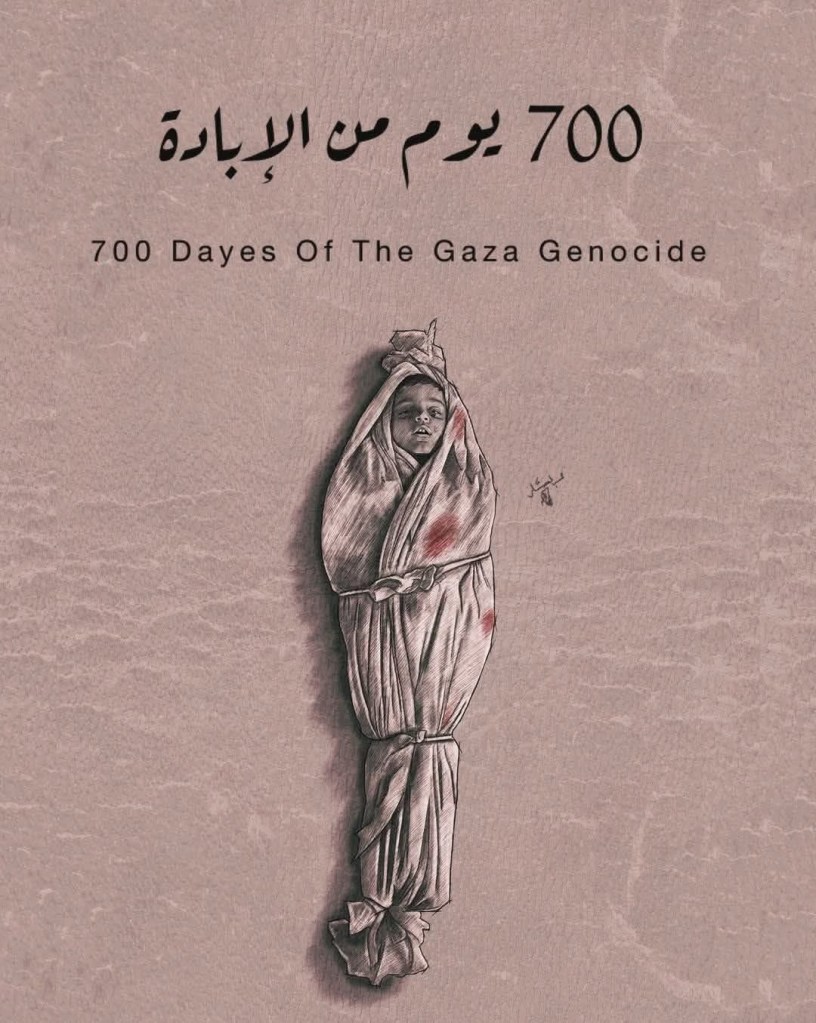
They experienced one day of national trauma.It’s not a holiday, but it’s etched into the memories of most Americans who were alive that day. Today marks 700 days of the most recent genocide in Gaza and 77 years of occupation since 1948. Is the trauma Palestinians experienced not only etched in our memories, but perhaps now our DNA?
How does one cope with one traumatic experience versus someone like me, or the Palestinians in Gaza whose trauma is ongoing? There is no ‘Post’ in traumatic stress disorder for Palestinians—it’s ongoing.
And yet, in that moment, my mind was somewhere else. I thought about the relentless genocide in Gaza—how hundreds are being killed every day and how hundreds of thousands of Palestinians have been killed for simply being Palestinian—how millions of Palestinians are living in refugee camps and diaspora. Just today, a bus full of women and children was targeted and killed by Israel. Mushatha Tower, one of the biggest buildings in Gaza City and a place where hundreds of Palestinians had taken refuge, was bombed and many were killed, injured, and now homeless. Not to mention, that Gaza has been under siege by israel by land, sea and air for 18 years! And after the attack, the Minister of Defense Israel Katz boasted and threatened to bomb another. Who mocked 9/11 when that tragedy happened?
As I kept reading, I was pulled deeper into the stories—stories I can relate to. I was alive during the Second Intifada. I lived in Palestine. I experienced those same checkpoints, those same raids, curfews, electricity and water outages—those same nights of uncertainty. So many of the martyrs mentioned—I remember the days they were killed and how they were killed. I remember their names.
I said nothing. I was split in two—remembering, reading, listening, feeling, all at once.
How am I even capable of that?
And how do I put these feelings into words?
I understood their sadness. I really did. But I also felt numb.
How do I explain that their 9/11 is Palestine’s 24/7?
Where do I begin?
I’m screaming inside!
Why won’t anyone hear me?
Why won’t anyone listen?
Why doesn’t anyone want to listen?
Please—do something for Palestinians! From the river to the sea, my people are suffering.
There is an active genocide happening. An ethnic cleansing!
How do I undo the social engineering that’s made them believe my people are anything but ordinary human beings—people who just want to live like everyone else? My people are beautiful, bright, sophisticated, intelligent, funny, and extraordinary. Truly extraordinary.
How do I tell them that perhaps they have misjudged who the ‘chosen people’ are…and perhaps we are the ‘chosen people’? Not to rule or dominate, but because God wanted us to be an example to the world—so that we may endure and one day be rewarded with an eternity of abundance of food, fresh water, beautiful gardens and peace.
Perhaps… I should just leave it to God.
 Layla Darwish